
Yard Drainage & French Drain Installation in Hampton, VA
Yard drainage and French drain installation in Hampton, VA assesses yard water problems and selects an appropriate drainage approach, rather than applying one solution to every wet yard. Water issues have causes, and a French drain is one option among several, not a universal answer. Request an Estimate to describe your drainage problem, or call 757-801-3219 to discuss it.
Tell Us About Your Drainage Problem
Describe where water collects, when, and where you think it should go.
Project Needs & Drainage Fit
Where Water Originates & Collects
Homeowners call about drainage when water stands on the lawn after rain, when a low spot stays soggy, when runoff from a slope or downspout floods a planting bed or patio, or when the ground near the foundation stays wet. The visible problem is water where it should not be; the cause is usually how water moves, or fails to move, across the property.
Surface Water vs. Subsurface Moisture
Where water originates, collects, and can appropriately discharge is the framework for any solution. Surface water, the runoff that moves across the ground, and subsurface moisture, the water that moves through the soil, are different problems that call for different approaches. Drainage observations and a site assessment identify which is at issue, because a surface runoff problem and a subsurface seep problem are not solved the same way.
What Should Be Assessed First
Before recommending a solution, it helps to assess the source of the water, the path it takes, the low spots where it collects, the soil, and where water can legitimately go. French drains, surface collection, grading adjustments, and other relevant options each suit different situations. Access for maintenance is considered, since a drain that cannot be maintained will fail over time. And critically, water cannot simply be discharged onto a neighboring property or into an unverified outlet; the discharge point is part of the assessment.
Approaches, Outlets & Coordination
French Drains, Surface Collection & Grading
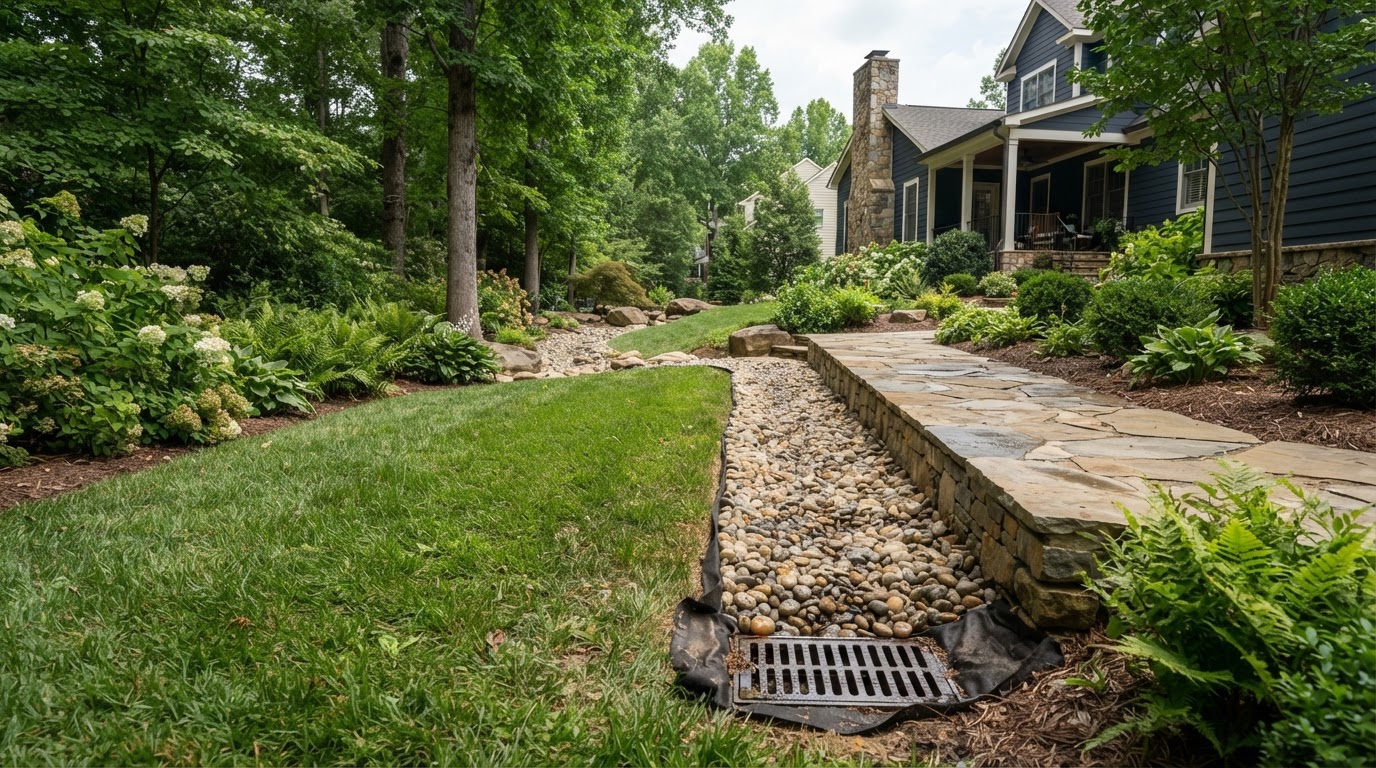
French drains, surface collection, and grading adjustments are different tools. A French drain collects subsurface water through a perforated pipe in aggregate; surface collection uses grates or swales to capture runoff; grading reshapes the ground so water moves where it should. The right tool depends on whether the problem is subsurface or surface, and on the site, so the approach follows the assessment rather than defaulting to a French drain.
Discharge Points & Maintenance Access
Discharge points and maintenance access are planned into any drainage work. Water must outlet to a legitimate point, whether a storm system, a suitable area of the yard, or another approved location, and discharging onto a neighbor's property or into an unverified outlet is not an acceptable plan. Access for maintenance, such as cleanouts and grates that can be cleared, keeps the system working. A drainage solution that cannot be maintained is a temporary one.
Coordination with Landscaping & Hardscaping
Coordination with existing landscaping and hardscaping matters because drainage work often runs through or near planting beds, patios, and walls. A drain through a patio area, a French drain along a planting bed, or grading that reshapes a lawn all need to integrate with what is there. The drainage plan is coordinated with the landscape and hardscape so the solution does not create a new problem in the yard it is meant to help. Detailed patio drainage and downspout-extension work have their own considerations covered separately.
Assessing & Installing Drainage
Site Assessment & Drainage Plan
Installation begins with a site assessment and a drainage plan. The source, path, collection points, soil, and discharge options are reviewed, and the approach, whether French drain, surface collection, grading, or a combination, is designed to the site. The plan identifies where water will go before any digging starts.
Trenching, Pipe & Aggregate
Trenching, pipe, and aggregate follow the plan. A French drain is trenched, lined, filled with aggregate, and fitted with perforated pipe pitched to carry water; surface collection uses grates, basins, or swales; grading reshapes the ground. Each approach has its own installation, and the work is sequenced so the yard is not left in disarray. The installation follows the design rather than improvising the path.
Discharge, Restoration & Maintenance
Discharge, restoration, and maintenance complete the work. The outlet is connected to the approved discharge point, the disturbed landscape is restored, and maintenance access is left clear so the system can be kept working. The closing step is reviewing the drainage path and covering maintenance guidance. The sequence adapts to the site, the approach, and the weather, and no drainage solution is a guarantee against all flooding, which is stated honestly.
Cost Factors, Related Services & Hampton Coverage
What Affects a Drainage Estimate
Estimates reflect the length and extent of the drainage work, the approach selected, existing conditions, access, the trenching and pipe or aggregate required, the discharge point, and landscape restoration. Surface collection, French drains, and grading carry different scopes. A single French drain and a multi-part drainage plan with restoration carry different estimates.
Related Services & Local Coverage
Related completed services include Yard Grading & Landscape Leveling, Permeable Paver Installation, Retaining Wall Installation, and Paver Repair & Restoration. We serve Hampton and the surrounding communities shown on our service-areas overview. For an estimate matched to your water problem, Request an Estimate or call 757-801-3219.
Yard Drainage Questions
These questions come up often when Hampton homeowners consider yard drainage.
Related Services
Discuss Your Yard Drainage & French Drains Project
Tell us about your property and your goals, and we will help plan the right approach for your Hampton outdoor space.