
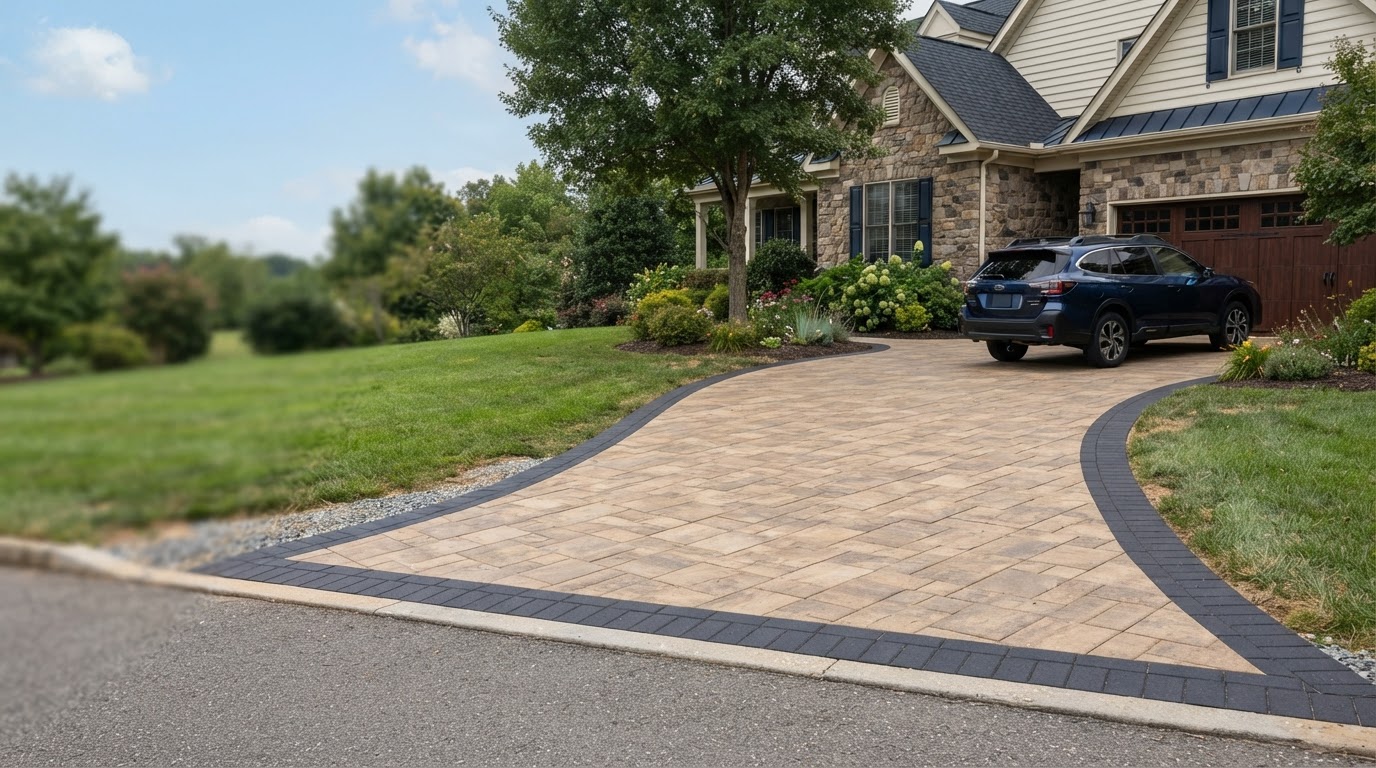
Paver Driveway Installation in Hampton, VA
Paver driveway installation in Hampton, VA builds a paved surface engineered for vehicles, not just foot traffic. Because a driveway carries turning and stopping loads every day, the paver, base, and edge restraint all have to be matched to that use. Request an Estimate to describe your driveway, or call 757-801-3219 to discuss it.
Request a Paver Driveway Estimate
Tell us about your driveway surface, vehicles, and access.
Project Needs & Driveway Fit
Vehicle Use & Loading Considerations
Homeowners choose a paver driveway for curb appeal, to replace a cracked concrete or asphalt drive, or to gain a surface that can be repaired in sections. The visible goal is usually an attractive entrance; the structural goal is a surface that holds up under daily vehicle use without rutting, spreading, or settling.
Layout, Access & Turning Areas
Vehicle use and loading shape every other decision. A single-car residential drive and a drive that serves trucks or multiple vehicles carry different demands, and the paver, base depth, and compaction must suit the load. Driveway layout, turning areas, and access are planned so vehicles can enter, park, and turn without running off the edge. Transitions to the street, sidewalk, and garage are detailed so the drive meets them cleanly.
What Should Be Assessed First
Before choosing materials, it helps to assess the existing driveway, the subsoil, drainage, and how water currently moves across the area. A driveway that sheds water toward the garage or traps it at the street creates problems no paver pattern can hide. Existing driveway removal is reviewed when an old surface is present, and access for excavation equipment is confirmed up front. These conditions vary by property, so the plan reflects the specific site.
Materials, Borders & Site Conditions
Paver Suitability for Vehicle Loads
Not every paver is suitable for a driveway. Material suitability and project-specific base design are matched to vehicle use, since a paver strong enough for a patio may not hold up under a turning truck. Concrete pavers rated for vehicular loads, appropriate thickness, and the right pattern all factor in. The choice is driven by the load the drive will carry, not by appearance alone.
Base Design & Edge Restraint
Base design and edge restraint keep a driveway stable. A compacted aggregate base built to the project's loading, proper compaction, and a robust edge restraint along the perimeter prevent the surface from spreading under turning tires. Water movement is planned so the drive sheds runoff to an appropriate outlet rather than pooling or running toward the home. These are project-specific specifications, not universal dimensions.
Borders & Walkway Connections
Borders and visual connections to walkways let the driveway tie into the rest of the property. A contrasting border frames the drive and defines its edge, and a connecting walkway can be planned with matching or complementary pavers. Because the driveway and walkway carry different loads, their base preparation differs even when they share a material. Site conditions influence all of this, so a solution that suits one Hampton lot may not transfer to the next.
Planning & Installing a Paver Driveway
Removal & Site Preparation
Installation begins with removal and site preparation when an existing driveway is present. The old surface is broken out and hauled, the subgrade is graded and compacted, and drainage flow is established across the area. Equipment access and overhead clearance are confirmed so excavation proceeds without disruption.
Base & Drainage for Vehicle Loads
Base and drainage for vehicle loads follow. The aggregate base is placed and compacted in lifts to the depth the project requires, the slope is set to move water to an appropriate outlet, and edge restraint is installed along the perimeter. Geotextile may be used to separate the subgrade from the base where soil conditions warrant. These steps are heavier than a patio base because the surface must carry vehicles.
Laying, Compacting & Edging
Laying the pavers follows the chosen pattern, with cuts placed at edges and any obstacles. The pavers are compacted to seat them into the setting layer, joints are filled and stabilized, and the edge restraint is finalized. The closing step is reviewing the finished surface, slope, and transitions and covering care guidance. This is a reasonable sequence; the details adapt to weather, access, and the specific driveway.
Cost Factors, Related Services & Hampton Coverage
What Affects a Paver Driveway Estimate
Estimates reflect driveway area, the paver material and thickness, existing conditions, access, base preparation depth, and removal or disposal of an old surface. Elevation changes, drainage integration, border details, and transitions to the street or garage add detail. A straightforward rectangle and a curved drive with a border and drainage work carry different estimates at similar area.
Related Services & Local Coverage
Related completed services include Paver Installation, Permeable Paver Installation, Paver Walkway & Sidewalk Installation, and Paver Cleaning & Sealing. We serve Hampton and the surrounding communities shown on our service-areas overview. For an estimate matched to your driveway and vehicles, Request an Estimate or call 757-801-3219.
Paver Driveway Questions
These questions come up often when Hampton homeowners plan a paver driveway.
Related Services
Discuss Your Paver Driveway Installation Project
Tell us about your property and your goals, and we will help plan the right approach for your Hampton outdoor space.