
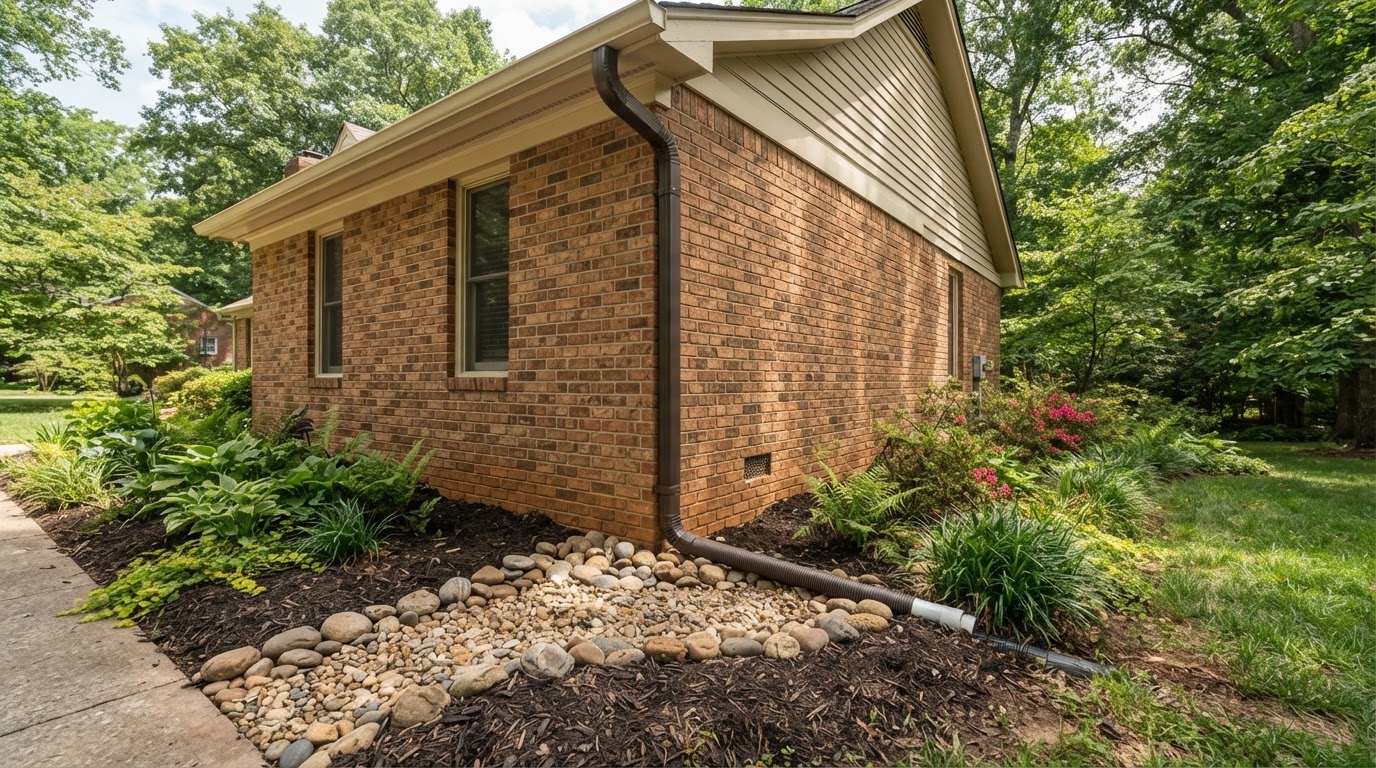
Downspout Drainage Extensions & Underground Drain Installation in Hampton, VA
Downspout drainage extensions and underground drain installation in Hampton, VA plans appropriate routing of roof runoff away from problem collection areas. When downspouts discharge next to a foundation, across a patio, or into a low spot, the concentrated water can cause wet areas, erosion, and moisture concerns near the home. Request an Estimate to describe your issue, or call 757-801-3219 to discuss it.
Discuss Your Downspout Drainage
Tell us where downspouts discharge and where water is collecting that you want to address.
Project Goals & When This Service Fits
Existing Downspout Discharge
Existing downspout discharge is the starting point. Observing where each downspout currently releases water, where that water flows, and where it collects identifies the problem. A downspout that dumps onto a patio, into a planting bed against the foundation, or at a low corner creates a concentrated flow that extensions or underground drains can redirect. The current discharge pattern is mapped before any routing is planned.
Surface Versus Underground Routing
Surface versus underground routing is a key decision. A surface extension, a visible pipe or channel that carries water to a better spot, is simpler and easier to inspect but may be in the way or unattractive. An underground drain hides the routing and keeps the surface clear but needs sufficient slope, cleanouts for maintenance, and a suitable outlet. The choice depends on the site, the distance, the available slope, and how the area is used, not on one being universally better.
Elevations & Outlet Suitability
Elevations and outlet suitability determine whether routing is even possible. An underground drain needs enough fall to carry water, and the outlet must be at a lower elevation than the inlet and must discharge to a place that can accept the flow, whether a storm system, a surface area, or a suitable dispersion point. If the outlet is not verified or the slope is insufficient, the routing may not work, and that is identified before installation rather than discovered after.
Options, Materials & Scope
Utilities & Landscape Features
Existing utilities and landscape features must be considered before any underground routing. Buried lines, irrigation, tree roots, and existing structures can all affect the route, and digging without checking risks damage. The route is planned around what is already there, and where utilities are uncertain, the appropriate verification is part of the process rather than assuming a clear path.
Connections to Patios & Planting Beds
Connections to patios and planting beds are often part of the project. A downspout that drains across a patio may be routed beneath or around it, and one that floods a planting bed may be redirected to protect the plants. The routing is coordinated with the existing hardscape and landscape so it does not create new conflicts, and transitions to drains, surface channels, or dispersion points are detailed cleanly.
Appropriate Discharge Requirements
Appropriate discharge requirements govern where the water can go. Connection to a public storm system may be allowed only with approval and is not assumed; discharging onto a neighboring property is not appropriate; and an underground pipe does not guarantee a dry foundation if the water has nowhere to go. The outlet is chosen to be suitable and lawful, and where no suitable outlet exists, that limits the options and is reported honestly rather than forcing a drain that cannot work.
Planning & Installation Process
Assessment & Route Planning
The process starts with assessing the current downspout discharge, the elevations, the available slope, and potential outlets. The route is planned, surface or underground routing is chosen, and existing utilities and landscape features are considered. A suitable outlet is confirmed before any work begins.
Trenching, Pipe & Cleanouts
Trenching, pipe, and cleanouts install the routing. For an underground drain, the trench is cut to the needed depth and slope, the pipe is laid, and cleanouts are placed for future maintenance. For a surface extension, the routing is installed and secured. Connections to the downspouts and transitions are detailed so water moves efficiently. This stage is what makes the drain function rather than just exist.
Outlet Detailing & Maintenance Access
Outlet detailing and maintenance access complete the system. The discharge point is detailed to prevent erosion, with stone or a dispersion device as appropriate, and cleanouts or access points are left accessible for inspection. The closing step reviews the flow, the outlet, and care guidance, including checking the system periodically. The sequence adapts to the routing type and the site conditions.
Estimate Factors, Related Services & Coverage
What Affects a Downspout Drainage Estimate
Estimates reflect the number of downspouts, the routing length, whether the route is surface or underground, the trenching and pipe required, cleanouts and access, the outlet detailing, and any utility or landscape coordination. A short surface extension and a long underground drain with multiple cleanouts carry different scopes. The available slope and outlet also influence the approach.
Related Services & Hampton Service Area
This is a specialty under Yard Drainage & French Drain Installation. Related specialty services include Patio Drainage & Standing Water Repair, and related core services include Yard Grading & Landscape Leveling and Landscape Design & Installation. We serve Hampton and the surrounding communities shown on our service-areas overview. For an estimate matched to your runoff, Request an Estimate or call 757-801-3219.
Downspout Drainage Questions
These questions come up often when Hampton homeowners consider routing roof runoff.
Related Services
Discuss Your Downspout Drainage Extensions Project
Tell us about your property and your goals, and we will help plan the right approach for your Hampton outdoor space.